Tuesday, 5 September 2017

ICT Integrated Assessment Practices
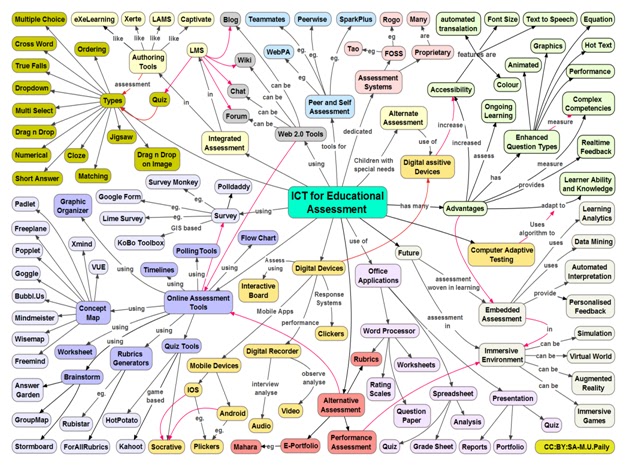
ICT Integrated Assessment Practices


Assessment plays a major role in student learning. There are many new approaches to assessment with an emphasis on the process of learning along with the product of learning. Performance based authentic assessment is emphasized world over. In India also there is an emphasis on continuous and comprehensive evaluation of students’ learning. Development in information and communication technology has thrown open numerous possibilities for assessing student learning and providing feedback.

Assessment is the process of identifying, gathering and interpreting information about students' learning. Assessment involves using wide variety of methods and tools to evaluate, measure, and document the student learning. Assessment basically helps one to improve learning and also set direction for ongoing teaching and learning process.

Types of Assessment
Assessment can be classified in to various types or approaches based on the purpose for which it is designed. It can be classified as follows:
Formative Assessment: Formative assessment provides feedback and information during the instructional process, while learning is taking place, and while learning is occurring.
Summative Assessment: Summative assessment takes place after the learning has been completed and provides information and feedback that sums up the teaching and learning process.
Diagnostic Assessment: Diagnostic assessment can help you identify your students’ current knowledge of a subject, their skill sets and capabilities, and to clarify misconceptions before teaching takes place. Knowing students’ strengths and weaknesses can help you better plan what to teach and how to teach it.
Authentic Assessment: The term authentic assessment describes the multiple forms of assessment that reflect student learning, achievement, motivation, and attitudes on instructionally relevant classroom activities. It Emphasizes what students know, rather than what they do not know or requires students to develop responses instead of selecting them from predetermined options. An authentic assessment usually includes a task for students to perform and a rubric by which their performance on the task will be evaluated.
Performance Assessment:  Performance assessment is one which requires students to demonstrate that they have mastered specific skills and competencies by performing or producing something.

ROLE OF ICT IN ASSESSMENT

Technology has a vital role to play in effective and efficient assessment of learning. Modern technology offers educators a variety of new tools that can be used in the classroom. Technology can help teachers assess their students' learning as well as their performance in the classroom. Use of ICT in assessment involves the use of digital devices to assist in the construction, delivery, storage or reporting of student assessment tasks, responses, grades or feedback.
Geoffrey Crisp (2011) in the Teacher's Handbook on e-Assessment stated that the ICT based assessment can be undertaken with many devices, such as traditional desktop computers or laptops, with portable communication devices such as smart mobile phones, with digital devices such as iPads or through the use of electronic gaming devices. ICT based assessment can use a multitude of formats, including text documents or portable document formats, multimedia formats such as sound, video or images; it can involve complex simulations or games; it can also be undertaken by students in groups or individually and it can occur with large numbers of students in a synchronous or asynchronous manner.
Teachers can use computers to construct their assessment tasks, to deliver these tasks to relevant students and to record and provide feedback and grades to these students. Computers can also be used to analyse students' responses, both to provide feedback to the student on the quality and relevance of their response, as well as to provide feedback to the teacher on whether the task can differentiate between students with different abilities. ICT based assessment can be used to test many different capabilities and skills that are developed by students. There are only a few tasks that might not be suitable for completing and recording electronically, but the number of such tasks is rapidly diminishing as technology becomes more sophisticated and widespread. In many disciplines laboratory equipment can be manipulated remotely and students can undertake real time physical performances that are able to be recorded and used for assessment purposes. We are quickly approaching the stage where our imaginations will be the limiting factor in designing e-assessment tasks.
Christine, R. (2013) identified two conceptually different approaches to assessing Key Competencies using ICT. On the one hand, Computer-Based Assessment (CBA) approaches have been employed for more than two decades and now go beyond simple multiple choice test formats. With this new "Generation Re-Invention" or "transformative" testing, questions are increasingly integrated into more complex and authentic problem contexts, so that the full range of Key Competencies can be assessed. Additionally, due to technological advances, a wider range of answer formats, including free text and speech, can be automatically scored.
On the other hand, technology-enhanced learning environments offer a promising avenue for embedded assessment of the more complex and behavioral dimensions of Key Competencies, based on Learning Analytics. Many of the currently available technology-enhanced learning environments, tools and systems recreate learning situations which require complex thinking, problem-solving and collaboration strategies and thus allow for the development of generic skills. Some of these environments allow learners and teachers to assess performance, understand mistakes and learn from them.

Saturday, 2 September 2017

E-content Design and Development

E-content Design and Development

Wide varieties of digital materials which are of educational significance are available online. Some of the quality materials which are available free of cost or with minimum restrictions can be used, re-used and modified by teachers and students for their teaching and learning.  As textbooks are too expansive, the students are switching from textbooks to digital course materials. These materials provide both teachers and students a greater interactivity and social collaboration. One of the materials which can be designed and developed used, re-used and distributed is e-content. 
E-content is becoming popular because of it’s flexibility of time, place and pace of learning. E-content includes all kinds of content created and delivered through various electronic media. E-content is available in many subjects and almost all levels of education. It can be used by wide variety learners with diverse needs, different backgrounds, and previous experience and skill levels. It can be shared and transmitted easily and promptly among unlimited number of users around the world. Teachers, students and others get benefited by the use of well designed and developed e-content. It is advantageous to the educational organizations to make their program accessible to their teachers and students on campus, home and other community learning or resource centers.  It has a significant implications for open and distance learning institutions.  
Well developed e-content can be delivered many times to different learners. Individual course components i.e. units, lessons and media elements such as graphics and animations can be re-used in different contexts.

Designing and Development of E-content
The purpose of e-content development is to create an information rich society. Every one in the society is empowered to create, receive, share and utilize information for their progress. Very well designed, developed and validated e-content will provide access to high quality meaningful digital content and serve as an effective virtual teacher.
E-content design, development and approach will depend upon the nature of the content and the learners. It will also depend on the quality and complexity the learning you wish to create. Various instructional design models are available according to our requirements. Most of the models involve the process of analyzing the learner needs and goals of the instructional material development, development of a delivery system and content, pilot study of the material developed, implementation, evaluating, refining the materials etc. In designing and development of E-content we have to adopt one of the instructional design models based on our requirements. Before understanding the designing and development of e-content it is essential to understand the meaning of instructional design.

Analysis: It is the first phase of this model meant for examining the suitability of the e-content to be developed. It is related to analyzing the learning needs, context, learner, task and content. Analyzing the learning needs is identifying the needs from the perspective of different learners, teachers, subject experts, practitioner, policy makers etc. Needs are to be clearly stated.
  • Contextual analysis is collecting data related to the context of learning such as learning environment. Whether the e-content developed is for the individual or group, formal or informal, facilitated or self-learning etc.
  • Learner analysis is collecting data related to learners academic levels and attributes such as skills, motivation, visual literacy, language competency, learning styles etc. That is nothing but preparing the learner profile. It helps to know about the learner.
  • Task analysis is stating the purposes of developing the e-content. Deciding whether that is developed for educating, training, creating awareness, developing skills etc.
  • Content analysis is nothing but preparing a content outline. Good content comprehension is required before designing and developing content. It includes verifying the content with respect to cognitive appropriateness, factual accuracy, completeness etc. It also includes classifying the content into facts, concepts, principles, processes and procedures.
Design: It is concerned with defining the learning objectives, structuring the content logically, specifying the instructional and evaluation strategies, and preparing for visual and technical design.
  •  Learning objectives are to be defined in clear, realistic and measurable terms. Learning objectives are the statements that describe what the learner will be able to do at the end of the course or program. Learning objectives should specify performance and communicate their purposes. Prepare a detailed content outline in which content is thoroughly analyzed and logically organized.  Content is to be structured logically following simple to complex, known to unknown, concrete to abstract, general to specific etc.
  • Instructional strategies are to be stated clearly. Depending on the learning style and nature of the content we have to decide the appropriate instructional strategy. Appropriate media mix that is combination of audio, video, graphics, animation; simulation etc is to be decided.
  • Learner evaluation strategies such as practice, computer marked or tutor marked assessments, pretest, post-test, remedial tests etc are to be specified. We have to decide about the formative and summative assessments. Before developing the content for the selected course review the proposed learning objectives. Make sure that content, assessment tests and exercises match the objectives stated. Provide the information and knowledge required to meet the learning objectives.
Development: It is related to the creation of story board. Story board is nothing but scripting the entire course content. The term ‘story board’ is taken from film production. In a movie it indicates the visual representation of the various scenes.  In e-content development the story board describes step by step script of the final outcome of the e-content i.e. story board is created to provide a blue print of the course with each and every detail along with the content notes. The story board is created based on the objectives and instructional strategies. Here the developers create and assemble the content assets and learning objects. Programming and integration of all media elements into a cohesive multimedia package are the part of this phase.
Implement: In the implementation phase, materials are distributed to learners. A comprehensive implementation strategy document is developed. This document should cover the course curriculum, learning outcomes, method of delivery in terms of hard ware and soft ware requirements and testing procedures. Ensure that the web site is functional if the material is on the web site.
Evaluation: The evaluation phase consists of two parts i.e. Formative and summative evaluation. Formative evaluation is present in each stage of the ADDIE process. Summative evaluation determines the adequacy of the distributed materials in achieving the course objectives. Material is to be revised at all the stages based on the feedback received.

Thursday, 31 August 2017

Cooperative and Collaborative Learning

Cooperative and Collaborative Learning


When it comes to students working together, the terms collaborative learning and cooperative learning are often used interchangeably. But, while the purpose of these pedagogical methods is the same – to provide students with opportunities to engage with each other in thoughtful learning – there are some fundamental differences. So, it is important that teachers understand these if they are to be used effectively in the classroom.

The similarities between cooperative and collaborative learning

Here are just some of the similarities that exist between a cooperative and collaborative approach to learning for students:
  • Rely on active student participation rather than passive, lecture-based teaching
  • Students assume a degree of responsibility for their own learning
  • Teachers act as facilitators to learning
  • Require pupils to complete a task/project
  • Instil team building skills and encourage social interaction
  • Help to prepare students for the world of work
  • Enhance deeper cognitive skills
  • Create shared learning experiences
  • Increase levels of information retention
  • Embrace student diversity

The differences between cooperative and collaborative learning

Collaborative learning

Students make individual progress in tandem with others, working towards a common goal. Students are accountable to one another and, with appropriate direction, will self-manage this. Pupils learn to better understand and anticipate difference, recognise it in themselves and others, and use it to their advantage.
A typical collaborative learning process:
  • Students organise their efforts between themselves (group-structured)
  • Students source material to help them complete the activity
  • The activity is not monitored by the teacher (although they can help when assistance is requested by the group)
  • Students assess their own individual and group performance
  • Success depends on individual strengths
Cooperative learning
Co-operation involves inherent interdependence like the cast and crew of a theatre production, for example. Roles and responsibilities are clearly defined but are open for negotiation. This method of collaboration brings with it a strong sense of accountability.
In contrast to collaborative learning, a cooperative learning structure takes the following form:
  • Activities are structured with each student assigned a specific role (teacher-structured)
  • Teachers supply information for students to read and analyse (or let pupils know where this info can be found)
  • Teachers observe, listen and intervene where necessary
  • Students submit work at the end of lesson for evaluation/assessment
  • The success of the group depends upon the efforts of everyone involved

The benefits of cooperative and collaborative learning

The majority of students learn best when they are immersed in learning, through interaction and application. A student is more likely to remember something discovered through active participation and peer work than through the passive acceptance of information presented by the teacher.
As well as making learning more memorable, with collaborative and cooperative learning:
  • By working with their classmates, students come to recognise, understand and respect cultural differences and different perspectives
  • Performance is improved. With collaborative/cooperative methods much more valuable than individualistic ways of building student performance and progression
  • Group work helps students who have difficulty with social skills. Providing a safe and structured space to interact with others
  • Confidence is emboldened, with students able to recognise and value the importance of their contributions
  • Inclusivity is encouraged. There is no such thing as an average child, and collaborative/cooperative methods allow each child to work to their strengths. To help with this, tools such as ClassFlow let teachers create study groups (and assignments for cooperative learning) based on each pupil’s ability, level, and learning style. With this approach, children are more likely to play an active role and are less liable to become disengaged and frustrated
Despite the benefits, effective cooperative and collaborative learning does not necessarily come easy and may require a change of mindset for everyone involved. That said, it’s not an overwhelming proposition either. The world is already collaborating, and by using both cooperative and collaborative methods, teachers can help to create well-rounded citizens with the skills needed to succeed – not only in further education and work – but also their personal lives. After all, what we learn in childhood, we take into adult life.

Sunday, 27 August 2017

Self-Assessment Through Rubrics

Self-Assessment Through Rubrics

A key element of formative assessment is feedback. The trouble is, most teachers have difficulty finding time to give all students the feedback they need when they need it. Fortunately, students themselves can be excellent sources of feedback. Under the right conditions, student self-assessment can provide accurate, useful information to promote learning.

One way to support thoughtful self-assessment is to provide a rubric or create one with students. A rubric is a document that lists criteria and describes varying levels of quality, from excellent to poor, for a specific assignment (Andrade, 2000). Many teachers use rubrics for scoring student work, but rubrics can do much more. In the hands of students, a good rubric can orient learners to the concept of quality as defined by experts in a field, inform self- and peer assessment, and guide revision and improvement. Rubrics can be informative as well as evaluative. Unfortunately, some rubrics define quality for an assignment too narrowly, leading teachers to worry that rubrics result in cookie-cutter products from students and limited feedback from teachers. If that is the case, the rubric in question is a bad one and should be shredded. Popham (2006) contrasts a poor rubric description with an effective one. On a rubric to assess students' performance on a writing assignment about donating blood, in which one of the criteria is organization, a narrow, overly task-specific description of the highest level of performance might require that the piece "describe the importance of blood giving, the steps in giving blood, the impact of ‘Mad Cow’ disease, and the reasons people cannot give blood too frequently." A more effective description of the highest level of organization might state that the piece "contains an introduction, a body, and a conclusion. The structure is appropriate for the task: for instance, an order-of-importance, logical, or chronological structure." When carefully designed, perhaps collaboratively with students, good rubrics can provide students with important guidelines without constraining creativity and can be a boon to self-assessment. The process of rubric-referenced self-assessment involves three basic steps

Setting Clear Expectations

The expectations for the task or performance should be clearly articulated by either the teacher, the students, or both. Because students become better acquainted with the task at hand when they are involved in thinking about what counts and how quality is defined, I often create all or part of my rubrics in class with students.


Conducting Self-Assessment

 Students create rough or first attempts at their assignment, be it a story, word problem, lab report, baseball bat swing, or speech. They monitor their progress on the assignment by comparing their performances to the rubric.

Revising

 Students use the feedback from their self-assessments to guide revision.The revision step is crucial. Students are savvy, and they will not self-assess thoughtfully unless they know that their efforts can lead to opportunities to actually make improvements.


Sunday, 20 August 2017

Video Conferencing

Video Conferencing


What is Video Conferencing?
 Video conferencing or video communications is the ability to communicate with other people as if they were in the same room. For video conferencing to really succeed, participants need to be able to see, hear and use meeting tools regardless of whether participants are in the same room or across the other side of the world. Video conferencing is defined as: “a live connection between people in separate locations for the purpose of communication, usually involving audio and often text as well as video. At its simplest, videoconferencing provides transmission of static images and text between two locations. At its most sophisticated, it provides transmission of full-motion video images and high-quality audio between multiple locations.”

Video conferencing, as a technology, has been around for approximately 40-50 years. However,
the growth of video conferencing has depended heavily on the availability to run on a reliable
digital communications network. It wasn’t until the early 1990’s that ISDN standards were
introduced and, finally, video conferencing could begin to grow.
Systems in the mid to late 1990’s were expensive and only really a technology that larger
multinational companies could afford and then only at the higher levels in the organisation. The
decrease in endpoint price, increase in quality and functionality as well as global events, such as
the Gulf wars, increased terrorist activity and, more recently, climate change concerns have
fuelled the growth of video conferencing. In addition, just as the standardisation of ISDN networks
fuelled the initial adoption in the early 1990’s, the ability to run video conferencing over computer
data networks has also fuelled growth in the past three years or so. 

Videoconferencing can speed up business processes and procedures in the same way that e-mail has revolutionised the way we share information. The most common reason for implementing video conferencing is to save travel costs. However other benefits are often more important. First, it isn’t just the cost of travel but the cost of the time taken to travel. Travel also causes wear and tear on an individual which reduces their effectiveness. Business travel isn’t going to disappear completely but video conferencing can significantly reduce it and really make a difference to productivity. On top of the time saving benefits there are also significant benefits in changing the way we do business. Video conferencing greatly improves communication between remote sites both within a company and between suppliers and customers. Product or project development times can be decreased and easily involve experts where ever they are. This can increase profit and the quality of the end result. Meetings are often more effective over video and can be held more often. This, in turn, enables companies to make decisions within smaller time frames solving urgent problems more quickly and also enabling companies to react to market changes faster.

Video conference components :

Display

Cameras

Microphone

Amplifier Speakers

Echo cancellation

 Networks

Friday, 11 August 2017

Classroom Management


Classroom management is a term teachers use to describe the process of ensuring that classroom lessons run smoothly despite disruptive behavior by students. The term also implies the prevention of disruptive behavior. It is a difficult aspect of teaching for many teachers. Problems in this area causes some to leave teaching. In 1981 the US National Educational Association reported that 36% of teachers said they would probably not go into teaching if they had to decide again. A major reason was negative student attitudes and discipline.[1] Classroom management is crucial in classrooms because it supports the proper execution of curriculum development, developing best teaching practices, and putting them into action. Classroom management can be explained as the actions and directions that teachers use to create a successful learning environment; indeed, having a positive impact on students achieving given learning requirements and goals (Soheili, Alizadeh, Murphy, Bajestani, Ferguson and Dreikurs). In an effort to ensure all students receive the best education it would seem beneficial for educator programs to spend more time and effort in ensuring educators and instructors are well versed in classroom management. Teachers do not focus on learning classroom management, because higher education programs do not put an emphasis on the teacher attaining classroom management; indeed, the focus is on creating a conducive learning atmosphere for the student (Eisenman, Edwards, and Cushman ). These tools enable teachers to have the resources available to properly and successfully educate upcoming generations, and ensure future successes as a nation. According to Moskowitz & Hayman (1976), once a teacher loses control of their classroom, it becomes increasingly more difficult for them to regain that control. Also, research from Berliner (1988) and Brophy & Good (1986) shows that the time a teacher must take to correct misbehavior caused by poor classroom management skills results in a lower rate of academic engagement in the classroom. From the student’s perspective, effective classroom management involves clear communication of behavioral and academic expectations as well as a cooperative learning environment. Douglas Brooks (1985) reports seminal research on the first day of school activity selection and sequence of novice middle school teachers compared with experienced, successful classroom managers. Brooks reports that effective classroom managers organized their activities on the first day of school consistent with the emerging needs of the students

CLASSROOM MANAGEMENT TIPS

Differentiated Instruction, Flexibility Make Multi-Age Classes Work
Multi-grade classes sound like a lot of work for teachers. But by regularly assessing students, differentiating instruction, and using flexible groupings, the experience can be revitalizing for a teacher. Included: Tips for planning lessons in multi-grade classes.
Goal Setting Made Easy
Teaching students how to set goals is easy with Goal Setting 101, a 3-part article that describes the process, and the Goal Tracker booklet, a student journal for recording goals and focusing on action steps.
Tools for Teaching Supplies Specifics for PBIS and RtI
The objective of Tools for Teaching for the past 40 years has been to develop specificclassroom management procedures that prevent both discipline and instruction problems.
The Hiring Process: A Little Research Never Hurts
Although you might be anxious to fill out applications and begin the interview process, it really is important that to take the time to do a little research first.
Motivational Tools
When trying to determine how to implement rewards in your classroom, you need to consider your goals, the kinds of incentives youll use, and the impact of the program on students.
Goal Setting 101: Setting Individual Goals
You dont have to wait to achieve a class goal before teaching students to set personal goals. The steps of the process are the same, although youll need to approach the task a little differently.

Freedoms and Responsibilities
Your goal should be to empower students to take a part in their own learning while being held accountable for their behavior and work product. That can be developed through a system of freedoms and responsibilities within the classroom.
Goal Setting 101: The Process in Action
As any effective teacher knows, telling isnt teaching. The best way to help students see the goal-setting process in action is to set a class goal and work together to achieve it.
Practicing Love & Logic Can Mean Happier Schools
Stressing positive teacher-student relationships, empathetic adults, and differentiated consequences, the Love & Logic approach to behavior management has fans among teachers and parents. Included: Nine essential skills for teachers practicing Love & Logic.
Goal Setting 101: Understanding the Process
Many of us never were taught how to set goals for ourselves, and we only discovered the power of goal setting later in life. But with a little creativity, we can adapt the strategies used by successful adults and share them with our students.
Setting the Tone
How can you develop a positive classroom environment that also embraces structure and accountability? How can you set just the right tone starting from day one? The key has everything to do with you -- your body language, eye contact, and tone of voice.

ESTABLISHING CLASSROOM RULES

Keeping Kids Above the Line
Above and below are concepts most children grasp at a young age -- so that is the basis for the Above the Line behavior management approach, which stresses teaching children to keep their behavior Above the Line and encourages them to fix it when its not.
School "Rules" -- Ten Activities for Establishing Classroom Rules
Starting the school year on the right foot includes establishing classroom rules that will last the whole year through. Many teachers involve students in establishing their classroom rules. (Surprisingly, student-created rules are often much the same as -- or even tougher than -- rules a teacher might create. After all, students want to attend school in a safe environment, and they want to know the boundaries when it comes to classroom behavior.)
School-Wide Rules Creation 
Learn about one school's efforts to improve school climate by developing a more consistent approach to discipline from classroom to classroom and in common school areas, such as the playground, lunchroom, and hallways.
Responsive Classroom Strategies: Teaching the Rules
We have generated our hopes and dreams. We have constructed our classroom rules, which are signed and beautifully and prominently displayed. We have shared our rules with parents. Now comes the interesting part, the part where we teachthe rules.
Logical Consequences Teach Important Lessons
Logical consequences help teachers intervene when children break rules. It is a strategy that reinforces the limits of the classroom, the accountability of each individual, and the belief that we can take better care of ourselves, one another, and our environment.
The Three R's of Logical Consequences
'Logical consequences' is a strategy that seeks to help children learn from their mistakes. A logical consequence has two steps: the first stops the misbehavior; the second recalls children to the rules and teaches alternative behaviors.
Examples of Logical Consequences 
The goal of logical consequences is to stop children's misbehavior and help them make more constructive choices. There is no one-size-fits-all consequence, although there are a few general categories that can help us consider effective implementation of logical consequences.
Tools for Teaching: Rules, Routines, and Standards
Classroom management expert Fred Jones explains why educators need to teach -- not just announce -- classroom rules and routines. In this month's column, he offers effective strategies for getting students to take your standards seriously.
The Essential 55: Rules for a Lifetime
Ron Clark, the author of The Essential 55: An Award-Winning Educator's Rules for Discovering the Successful Student in Every Child, discusses his classroom rules and the philosophy behind them.
Class Rules Smooth Way for the Year
Rules in School, a book from the Northeast Foundation for Children, tells teachers how they can regain instructional time during the school year by helping students develop class rules and consequences at the beginning of the year.

ESTABLISHING CLASSROOM REWARDS

Preferred Activity Time (PAT) Is Preferred by Kids and Teachers
If you talk with any group of teachers, you are likely to discover that at least one uses PAT, or preferred activity time, a reward system described by Fred Jones in his book Positive Classroom Discipline. Because this system requires little effort and expense, teachers are taking it up. Because it is fun, students are eating it up! Whether teachers view the time students earn as free time or educational game time, they all agree that PAT works. Included: Teachers share favorite educational games from their PAT repertoires.
Reward Systems That Work: What to Give and When to Give It!
Read about ways four teachers reward students' good behavior and motivation. Learn what to give and when and how you can encourage students to improve. Included: 35 reasonable rewards.
WANTED: Rewards, Rewards, and More Rewards!
Do rewards motivate students? Some say no, but many teachers think they do. This week, Education World takes a look at a wide variety of rewards used by teachers in the classroom. If you are looking for a way to reward successful students or good behavior, you might find the ticket here.
Classroom Rewards Reap Dividends for Teachers and Students
All teachers prefer to rely on their students' intrinsic motivation to encourage them to come to school, do their homework, and focus on classroom activities, but many supplement the internal drive to succeed with external rewards. The teachers say rewards -- free time, school supplies, or tasty treats -- can help kids master the expectations of acceptable classroom behavior and scholastic achievement. Included: Ten tips for using rewards in the classroom.
99 Ways to Say 'Very Good'
CareerLab, a "career strategy and human capital management firm," generously granted Education World permission to reprint 99 Ways To Say 'Very Good,' by Arzella Dirksen. CareerLab was more generous than the firm realized, however. The article actually contains 100 ways.
Carrots or Sticks? Alfie Kohn on Rewards and Punishment
Former teacher Alfie Kohn is an outspoken critic of the focus on grades and test scores. In an exclusive e-interview with Education World writer Cara Bafile, Kohn shares his views on classroom rewards and punishment and talks about how teachers can encourage intrinsic motivation. He also tackles the tough topics -- standards, accountability, and high-stakes testing.
Voice of Experience: The Power of Written Praise
Being roused from a sound sleep by a parent can be a rude awakening. But in one case it got educator Max Fischer reflecting about the power of written praise to raise student achievement. Included: Six reasons to put praise for students in writing.
Tools for Teaching: Having Fun with PAT
In Responsibility Training, students earn Preferred Activity Time (PAT) when they save time. Apart from curriculum enrichment activities, team competition is perhaps the most reliable and easy-to-use motivational "hook" in education. Anything can be taught in the form of a team game.
Token Economies Yield Promising Results
When classroom management is a struggle, the answer might be as simple as the traditional American "five and dime!" See how systems based on "token economies" can work with even the toughest classes.

Wednesday, 9 August 2017

Mental Health and Hygiene


MEANING OF MENTAL HEALTH


Generally a person who likes himself may be regarded as mentally healthy. Conversely strong dislikes of one’s self is a typical symptom of maladjustment. A mentally healthy individual feels that he is an accepted member of a social group and they in turn liked by him. But the maladjusted person may react in totally different way.

The concept of mental health is as old as human beings. Our ancient scriptures are full of references to mental diseases. But this concept is comparatively new even in the West. Burmham who emphasizes the importance of integration or wholeness of personality said “a mentally healthy person is one who has a balanced personality, free from schism and inconsistencies, emotional and nervous tension, discords and conflicts. a well adjusted person can deal with his potentialities as well as he can accept his limitations.”


Different authors emphasize different characteristics of a mentally healthy person. These can be studied under following heads.
(A) Indian Views (B) Western Views

Indian View:
Indian concept of mental health is available in the Atharva Veda which provides detailed information on mental disorder and their treatment. According to Artha Veda mental personality consists of three gunas or characteristics: Sattya, Rajas and Tamas. The inbalance of these gunas causes mental disorder. These gunas are in the mind since birth, but they keep certain equilibrium in a normal person. So normal mental health means living in Rajas and Tamas to a certain degree.

The Charak Samhita and Susrut have also given the concept of mental health, but they do not differ significantly from the Atharva Veda’s concept of mental health. These concepts of mental health are used in Aiurveda.

Western Concept: Though the concept of mental health is comparatively new yet different authors have given different views regarding sound mental health. Harry Stack Sullivaa says that a mentally healthy individual would place a major value on efficient social functioning.

Freudians lay emphasis on an awareness of one’s unconsciousness motivations and subsequent self control, based on the awareness.
Jahoda (1963), proposes six criteria of the mentally healthy individual. These are-

The ability to love adequacy in interpersonal relationship, efficiency in meeting situation requirements; efficiency in problem solving. 


Mental health is, thus, a condition of psychological maturity. It is a condition of personal and social functioning with a maximum of effectiveness and satisfaction. A mentally healthy person is responsible, self reliant and has a true sense of individuality. He has a realistic life goal as well as philosophy of life and values. He can differentiate between the right and the wrong.

According to Jacky Roy, a mentally healthy person possesses a good physical health. He can keep a good social relation too. He has insight into his action.
On the basis of the above discussion we can make the following observations.


Concept of mental health is subjective

Mental health is depending on sound physical health.

Measurement of mental health is difficult as we don’t have any standard.

Mental health depends on many factors.

Criteria of mental health may be different from country to country.

Mental health is synonymous to balance personality.

Mental health is a dynamic concept

Mental health is also related with stress and strain of life.
Let us see what are the factors which affect mental health.
Mental health plays a crucial role in the development of the personality but there are many factors which help in developing positive or negative development of mental health. Mental ill health is caused by different factors which have been described by different authors in different ways. Here we are presenting some of the models which explain the causes of mental ill health. These are –
 

Socio Cultural Model

Medical Model

Psycho Analytical Model

Behaviouristic Model

Interpersonal Model

Socio Cultural Model
 emphasizes the role of social condition, such as poverty discrimination, casteism, violence etc. as the basic causes of poor mental health.

Medical Model emphasizes the role of various organic conditions that affect our brain functioning.

Psycho Analytical model emphasizes the stress situations that involve a threat to the individual’s psyche. It gives importance to early childhood experiences as a major factor for mental ill health.

Behaviouristic model gives importance to faulty learning such as the failure to learn necessary adaptive behaviour.

The interpersonal model emphasizes the unsatisfactory interpersonal relationship among human beings.

Besides these models, different authors have given some more causes to understand the factors responsible for ill mental health. These are: 
 

Primary

Predisposing

Precipitating

Reinforcing

The primary cause is the condition without which the mental ill health would have not occurred.

predisposing cause is a condition that comes before and paves the way for later maladjustment For example: if a child is very much rejected in his early childhood, he may develop some mental disorder.

precipitating cause is a condition that proves too much to bear for the individual and triggers maladaptive behavior. For example, the sudden death of one’s father may cause mental disorder for that reason.

reinforcing cause is a condition that tends to maintain the maladaptive behavior already present such as playing a ‘sick role’ and relieved from unwanted responsibility say for family.

Let us now mention the factors responsible for mental ill-health. They can be listed as shown below:

A. Hereditary

Genetic defects

Chromosomal defects.

Faulty genes

Constitutional liabilities- physique, physical handicap etc.

Physical deprivation- Malnutrition, sleep disturbances emotional disruption, Brain pathology.

B. Psychological

Mental deprivation

Institutionalization

Deprivation in Home

Defective family pattern structure etc.

Early psychic Trauma


Severe stress.

C. Socio Cultural Factors

D. War and Violence

E. Group Prejudices

F. Economic and Employment Problems

G. Modernization and Globalization

CONCEPT OF MENTAL HYGIENE

Mental hygiene is a Science which deals with the process of attaining mental health and preserving mental health in the society. The term mental health is closely related with the term mental hygiene as the main objective of mental hygiene is to attain mental health. In other words, mental hygiene is a means of mental health. That is why we can say that mental hygiene is the means and mental health is the end.

Definition:
There are many definitions of the term mental hygiene. Some of the definitions are mentioned below:

According to Klien, “Mental hygine is an endeavour to aid people to ward off trouble as well as to furnish ways of handling trouble in intelligent fashion when it cannot be warded off.” To him, these troubles may be :

Illness

Finances

Social Position

Religion

Sex

Economic Security

Old age

Inadequate shelter etc.
According to Rivillin, mental hygiene –

Means the application of a body of hygiene information and technique.

It is taken from the sciences of Psychology, Child psychology, Education, Sociology, Psychiatry, Medicine and Biology.

It cares for the purpose of the preservation and improvement of mental health of the individual and community.

It is meant for prevention and cure of minor and major mental diseases and defects of mental, educational and social maladjustment.
The History of mental hygiene is old as our civilization. In India, Ayurveda successfully developed a full fledged system for treating the mentally ill people long back. But in the West the mental hygiene movement started in the first decade of the 20th century. Clifford Beers, a graduate of Yale University can be regarded as the father of mental hygiene. He being frustrated with his life once attempted to commit suicide in the year 1908. But luckily he was saved and treated for his mental illness. After recovery he wrote a book entitled “A Mind That Found Itself”-where he described about his illness and the type of treatment he had received. This book created a revolution among the general public for the necessity of mental hygiene. Gradually many Institute of Mental Hygiene were established in India as well as in many other parts of the World to train personnel in the field of mental hygiene.

Mental Hygiene is a science. The main objective of mental hygiene is to build up one’s ego rather than tearing down another’s ego. It tries to develop the power of tolerance and praise and discourages the habit of blaming others. Hence, we can say that the approach of mental hygiene is positive rather than negative.
The main objectives of the mental hygiene can be summarized as shown below-

To help to realizes one’s potentiality:
Every individual possess certain potentialities. Mental hygiene tries to help each individual to develop his/her potentialities.

To develop self-respect and respect for others:
Loss of self-respect is one of the factors for the great majorities of emotional disorders. A person who likes himself can like others and one who dislikes himself cannot like anybody. Hence, the main aim of mental hygiene is to help one to respect oneself.

To understand one’s limitations and tolerate the limitations of others:
Mental hygiene helps one to understand his own limitations as well as to tolerate others’ limitations.

To cause harmonious development : Mental hygiene aims at the harmonious development of the physical mental and spiritual capacities of the individual so that he can adjust himself in the environment.

To create happiness: Another objective of mental hygiene is to develop a positive attitude towards life so as to create a sense of happiness in a person who can live happily in this world.

To enable one to make effective adjustment: Mental hygiene also prepares an individual for effective adjustment in all sphere of life and all situations such as in school, home, society work and also with self.

To enable one to know his or her self : Many of us do not know our own self. We are not at all aware about our potentialities, weaknesses, limitations etc. for which many individuals suffer from different types of confusion. Mental Hygiene helps an individual to know himself.